

As the requirements for "connection reliability" in fields such as industrial fluid transmission and civil water and gas supply continue to upgrade, the problems of traditional joints, such as "poor sealing, easy corrosion and weak compatibility", have become increasingly prominent. Recently, a special brass joint designed specifically for valves and hoses has rapidly gained popularity in fields such as petrochemicals, municipal engineering, and home decoration, thanks to its excellent sealing performance, strong corrosion resistance, and precise compatibility. It has become a "safety link" for fluid transmission systems, promoting the transformation of valve and hose connections towards "high efficiency and long service life".
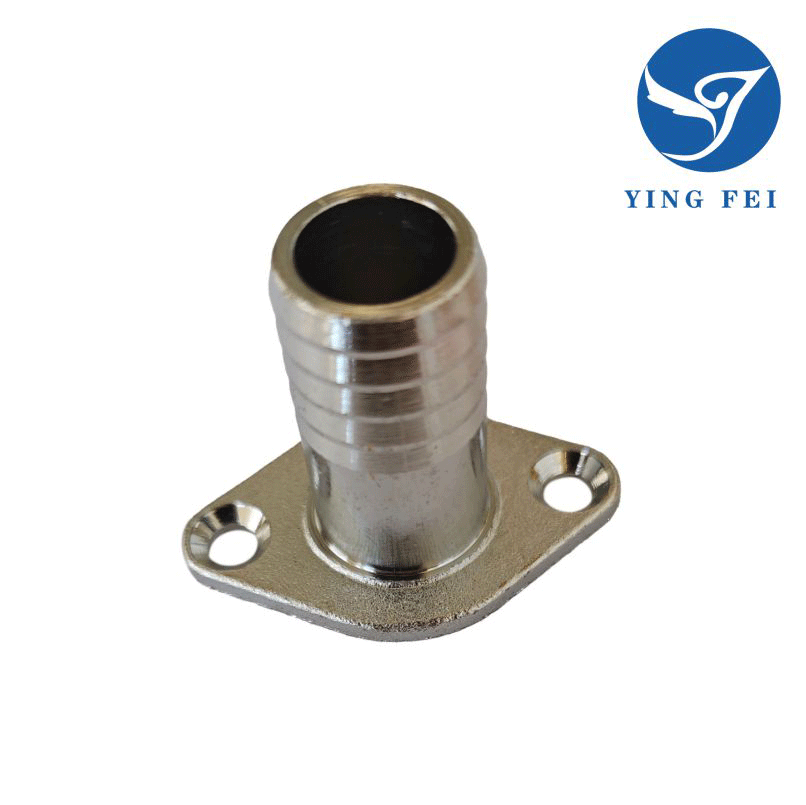
The explosion of market demand: The safety of fluid transmission has given rise to innovations in connection solutions
According to data from FlowControl, a global research institution in the fluid control industry, the global market size of valve and hose connection accessories exceeded 20 billion US dollars in 2025. Among them, the demand growth rate of "specialized brass joints" reached 38%, far exceeding the industry average. At present, fluid transmission scenarios exhibit the characteristics of "multiple media, high pressure, and complex environment" - in industrial scenarios, corrosive media such as crude oil and chemical solvents need to be transmitted, while in civilian scenarios, the safe transportation of tap water and gas must be ensured. However, traditional cast iron joints are prone to rust, plastic joints have poor pressure resistance, and ordinary brass joints have a simple sealing structure. It is difficult to meet the demand for long-term stable connection.
The emergence of special brass joints precisely addresses this pain point. Data from the hardware and building materials e-commerce platform shows that in the third quarter of 2025, the sales volume of this type of joint increased by 270% year-on-year. The procurement proportion in the petrochemical field reached 42%, and the procurement growth rate of municipal water supply projects exceeded 290%. "Previously, the ordinary joints we used in the solvent transportation pipelines of our chemical plant frequently leaked, requiring over ten to be replaced each month. After switching to special brass joints, there was no leakage for eight consecutive months, and the maintenance cost was reduced by 80%." " Mr. Wang, the equipment supervisor of a certain chemical enterprise in Shandong, provided feedback.
Liu Yue, an analyst in the fluid control industry, pointed out that as policies on "work safety" and "people's livelihood security" become stricter, "zero leakage and long service life" for the connection between valves and hoses have become hard requirements. With the core advantages of "superior material, good sealing and wide adaptability", the market size of special brass joints is expected to exceed 3.5 billion US dollars in 2025, with an average annual growth rate of over 52%, becoming the core growth point in the fluid connection accessories market.
Core Advantage Analysis: Four major features define the new standard for Secure connections
The special brass joint can quickly conquer the market, which is attributed to its all-round breakthroughs in material selection, sealing design and structural process, completely solving the core shortcomings of traditional joints:
High-purity brass material, excellent in both corrosion resistance and pressure resistance
This type of joint is made of high-purity brass in accordance with the national standard HPb59-1, with a copper content of ≥59% and an impurity content of less than 0.5%. It not only has a tensile strength of 320MPa but can also withstand a working pressure of 2.5MPa (far exceeding the standard of 1.6MPa for ordinary brass joints). It also has excellent corrosion resistance - in neutral water and weak acid and alkali environments, the salt spray corrosion resistance time can reach over 7,000 hours, which is four times longer than the service life of galvanized steel joints. It can still be stably used for more than six years in coastal high-salt spray areas and chemical corrosion environments.
Meanwhile, the joint strictly adheres to the EU RoHS and US NSF standards, free of harmful substances such as lead and cadmium, and can be directly used in scenarios for the transmission of drinking water and food-grade fluids. In our municipal water supply project, all valves and hoses are connected with special brass joints. The water quality test fully meets the standards, and there has been no corrosion or rusting after three years of use, significantly reducing the maintenance cost of the pipeline network. Mr. Zhang, the project manager of a certain municipal engineering company, said.
Triple sealing structure ensures zero leakage
To address the sealing pain points in fluid transmission, the dedicated brass joint innovatively adopts a "triple sealing design" : the first layer is a threaded seal. The internal threads of the joint are precisely rolled, with the pitch error controlled within 0.02mm. Combined with the dedicated sealing tape, a basic seal can be achieved. The second layer is O-ring sealing. The joint is equipped with oil-resistant and heat-resistant nitrile rubber O-rings inside, with the compression amount precisely controlled at 20%-30%, forming an elastic sealing barrier. The third layer is end face sealing. The contact surface between the joint and the valve/hose is mirror-polished, with a roughness Ra≤0.8μm, reducing the risk of leakage through gaps.
Third-party test data shows that the dedicated brass joint has a leakage rate of less than 0.01mL/h at a pressure of 2.0MPa, which is far superior to the industry's qualified standard of 0.1mL/h. In our hydraulic equipment, the special brass joints used for connecting valves and hoses have never leaked even in high-frequency vibration environments, and the operational stability of the equipment has been improved by 90%. Ms. Li, an engineer from a mechanical manufacturing enterprise in Jiangsu Province, provided feedback.
Precisely adapted design, compatible with mainstream valve hoses
To meet the connection requirements of different scenarios, the dedicated brass connectors adopt a "modular adaptation" design: the interface specifications cover mainstream thread models such as G1/2, G3/4, and G1, and are compatible with common valve types such as ball valves, gate valves, and globe valves, as well as hoses made of materials such as PVC, rubber, and stainless steel. The two ends of the joint are respectively designed as the "valve connection end" and the "hose connection end". The valve end is connected by rigid threads, and the hose end is equipped with detachable clamps, which are suitable for hoses of different inner diameters (10mm-50mm). No additional processing is required during installation, and one connection can be completed within 10 minutes.
Our maintenance team previously had to carry over ten different types of connectors. Now, with the dedicated brass connectors, three models can cover more than 90% of the valve hose connection requirements. The amount of tools carried has been reduced by 70%, and the maintenance efficiency has increased by 50%. Mr. Zhao, the supervisor of the maintenance department of a certain property, said. In addition, the joint surface is clearly marked with specification labels, which facilitates quick selection and avoids safety hazards caused by mismatching.
Anti-vibration and anti-loosening, suitable for complex working conditions
Considering scenarios such as industrial equipment vibration and thermal expansion and contraction of pipelines, the special brass joint incorporates an "anti-loosening design" in its structure: the threaded connection is coated with anti-loosening glue, making it less likely to loosen due to vibration after being tightened. The clamp at the connection end of the hose is made of stainless steel and is combined with a serrated groove, which can firmly lock the hose and prevent it from falling off due to pressure fluctuations. Meanwhile, the overall structure of the joint has been mechanically optimized, capable of withstanding a ±5mm pipe displacement and reducing the impact of thermal expansion and contraction on the connection.
We used special brass joints in the fuel pipeline of the diesel generator. During operation, the equipment vibrated violently. The previous ordinary joints often became loose and leaked. After switching to the special joints, there was no loosening during continuous operation for 12 months, ensuring the stable power supply of the generator. Mr. Chen, the logistics director of a power generation enterprise in Guangdong, said.
Multi-field applications: Covering all scenarios of fluid transmission
With the advantages of safety sealing, corrosion and pressure resistance, and wide adaptability, special brass fittings have permeated multiple fields and become the "universal solution" for valve hose connections:
In the industrial field, in the petrochemical industry, it is used for the connection of valves and hoses in crude oil and solvent transportation pipelines, and is resistant to corrosive media. The power industry is suitable for the cooling water pipes of generator sets to ensure no leakage under high pressure. It is used for aseptic fluid transmission in the food processing industry and meets hygiene standards. In the municipal field, this joint is used to connect valves and hoses of water supply pipelines and gas pipelines, ensuring the safety of people's livelihood transportation. The sewage treatment plant uses it to connect the sewage discharge valve and the hose, which can withstand the corrosion of sewage. In the civilian sector, special brass joints are widely used in the connection of water heaters, water purifiers and water supply hoses in home decoration, as well as in the connection of gas stoves and gas hoses in the kitchen, to eliminate potential safety hazards.
The product manager of an international hardware brand introduced: "Our special brass joints have passed 15 international certifications such as ISO 9001 and API 607. The global annual production capacity reaches 80 million pieces, serving more than 5,000 large-scale projects. From the low-temperature pipelines of Arctic research stations to chemical industrial parks in tropical regions, they can all operate stably."
Industry trend: Intelligence and greenness become new directions
With the development of the fluid control industry, dedicated brass joints are innovating in two major directions: On the technical front, the intelligent upgrade is accelerating - some brands have developed intelligent joints with built-in pressure sensors to monitor the pressure changes inside the pipeline in real time. When the pressure is abnormal, it sends a warning via wireless signals, which is suitable for unattended industrial pipeline systems. Meanwhile, an RFID chip is implanted on the surface of the joint, which can record production information, installation time and maintenance records, achieving full life cycle traceability.
At the material end, green sustainability has become the core - using recycled brass raw materials for production, with a recycled copper utilization rate of over 90%, reducing the mining of primary copper. Introduce degradable seals that can naturally degrade after being discarded, reducing environmental pollution. Optimize the production process, reduce energy consumption and wastewater discharge, and align with the global "dual carbon" strategy.
Industry insiders say that the rise of dedicated brass joints not only ensures the safety and stability of fluid transmission but also provides a "precise fit and long-lasting durability" connection model for the fluid control industry. In the future, with continuous technological breakthroughs, dedicated brass joints that feature intelligent monitoring, environmental friendliness, and adaptability to extreme environments will dominate the fluid connection market and safeguard the safety of fluid transmission in more fields.


