

With the acceleration of global infrastructure construction and the upgrading of civil pipelines, the "flexibility" and "sealing performance" of pipeline connections have become the core demands of engineering projects. Traditional fixed joints have problems such as high installation difficulty, inconvenient maintenance and poor adaptability, and are difficult to meet the requirements of complex pipeline systems.
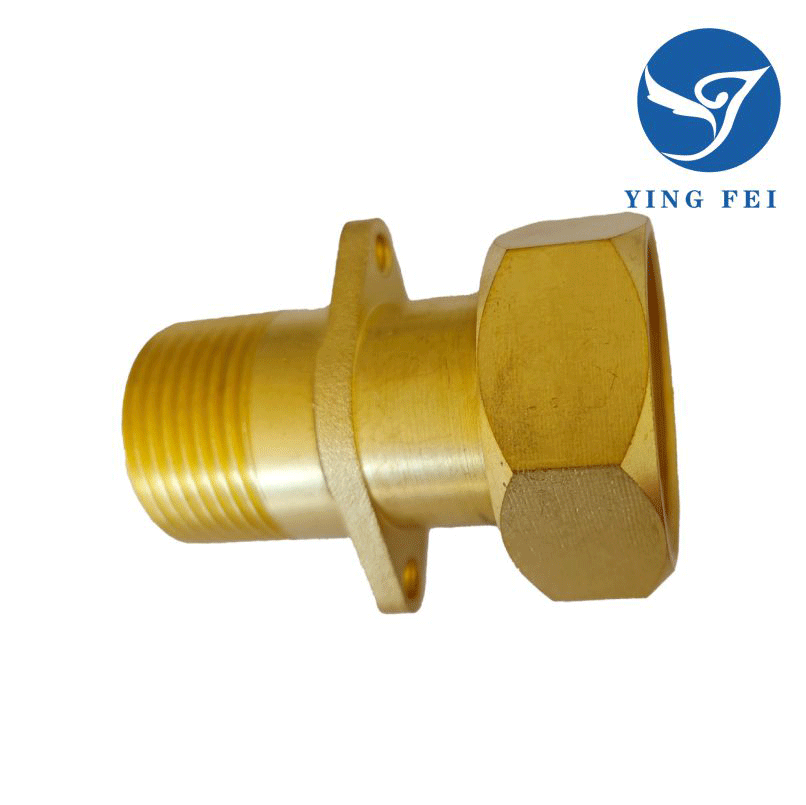
Recently, a brass G1 thread coupler made of high-purity brass and meeting the G1 universal thread standard has rapidly gained popularity in markets such as Europe, America, the Middle East, and the Asia-Pacific region, thanks to its excellent sealing performance, wide range of application scenarios, and long-term durability. It has become a "connection tool" for petrochemicals, building water supply, and HVAC systems. Promote the transformation of global pipeline connection technology towards "flexibility and safety".
Global demand surges: Pipeline upgrades drive innovation in connection solutions
According to data from PipeTech, a global research institution in the pipe industry, the global market size of industrial and civil pipes will exceed 800 billion US dollars in 2025. Among them, the demand growth rate for "flexible connection fittings" will reach 32%, far exceeding the industry average. At present, the pipeline system shows the characteristics of "mixed use of multiple materials" and "complex path arrangement" - in industrial scenarios, stainless steel pipes, copper pipes and plastic pipes often need to be cross-connected; In civilian scenarios, the renovation of old pipelines needs to be compatible with interfaces of different specifications. However, traditional fixed joints can only be adapted to a single material and a single specification. During installation, a large amount of customized processing is required, which leads to an extension of the project cycle by more than 30%. Moreover, during maintenance, the pipelines need to be cut off, which is costly.
The emergence of the brass G1 threaded coupler precisely addresses this pain point. Data from a global hardware and building materials e-commerce platform shows that in the third quarter of 2025, the sales volume of this type of joint increased by 260% year-on-year. The procurement proportion in the Middle East petrochemical sector reached 40%, and the growth rate of the European building water supply market exceeded 280%. During the water supply pipeline renovation of a hotel in Dubai, we needed to connect the existing cast iron pipes with new copper pipes. The traditional joints required welding for fitting, which took 3 days for each connection. After replacing them with brass G1 movable joints, there was no need for welding, and a connection could be completed in just 15 minutes. The entire project cycle was shortened by 40%. Khalid Mohammed, the project manager of an international pipeline engineering company, said.
It is worth noting that the "emergency repair demand" has further driven up sales. In Europe and America, due to its convenient installation, this joint has been included in the emergency material reserve for municipal pipelines and is used for the rapid repair of pipelines after earthquakes and floods. The emergency procurement volume in the first half of 2025 increased by 350% year-on-year.
Core Advantage Analysis: Four major characteristics define and connect new standards
The brass G1 threaded movable joint can conquer the global market, which is attributed to its all-round breakthroughs in material, structure and process, completely solving the core shortcomings of traditional joints:
High-purity brass material, combining strength and corrosion resistance
This joint is made of national standard HPb59-1 brass with a copper content of ≥62%, free of harmful substances such as lead and cadmium. It complies with the EU RoHS and US NSF drinking water safety standards and can be directly used in food-grade pipelines and drinking water systems. Brass material not only has a tensile strength of 320MPa and can withstand a working pressure of 1.6MPa (far exceeding the 1.0MPa standard of ordinary joints), but also has excellent corrosion resistance - in neutral water and weak acid and alkali environments, the salt spray corrosion resistance time is over 6,000 hours, which is three times longer than that of galvanized steel joints. It can still be stably used for more than five years in the high salt fog areas of the Middle East.
We used this joint in the seawater cooling pipeline of an oil platform in the Persian Gulf. The previous stainless steel joint showed signs of corrosion and leakage after six months. After replacing it with a brass G1 joint, there were still no signs of corrosion after two years of use, significantly reducing maintenance costs. Abdul Karim, the equipment supervisor of a certain oil company, gave feedback.
G1 universal thread, achieving "global compatibility"
As an internationally recognized standard for pipe threads, G1 thread (1-inch cylindrical pipe thread) is compatible with over 90% of medium and low-pressure pipe systems worldwide. Whether it is the EN standard in Europe, the ANSI standard in the United States, or the GB standard in China, brass G1 thread couplings can be directly compatible without the need for additional conversion accessories. The internal threads of the joint are precisely processed by a CNC lathe, with the pitch error controlled within 0.02mm. The tooth profile is clear and complete. When connected to the external threads of the pipe, only a small amount of raw material tape needs to be wound to achieve a tight seal, and the leakage rate is less than 0.01%.
Our cross-border pipeline project covers 12 countries. Previously, we had to purchase joints of different specifications for different regions, which made inventory management complex. Now, we uniformly use brass G1 movable joints, which are universal for global projects. Inventory costs have been reduced by 50%, and procurement efficiency has increased by 60%. Anna Costa, the purchasing director of a multinational engineering group, said. In addition, the surface of the joint is treated with nickel plating, which not only enhances the anti-rust performance but also reduces the wear of the threads. Even after being disassembled 50 times repeatedly, it can still maintain the sealing effect.
Activity structure design, flexibly responding to complex scenarios
Unlike the "rigid connection" of traditional fixed joints, the brass G1 threaded movable joint adopts a "rotary movable structure" - the main body of the joint is divided into a fixed end and a movable end. The movable end can freely rotate 360°. During installation, there is no need to precisely align the pipe Angle. Even if the pipe has a slight offset (≤5°), it can be adjusted and adapted through rotation. Significantly reduce the installation difficulty. Meanwhile, the movable end is equipped with an oil-resistant and heat-resistant nitrile rubber sealing ring inside, which remains sealed throughout the rotation process to prevent leakage caused by angular deviation.
This design advantage is particularly evident in the complex layout scenarios of industrial pipelines. In the installation of steam pipes in our chemical plant, the pipes need to go around the equipment to form a right-angle turn. Traditional joints require cutting the pipes to adjust the Angle. However, the brass G1 movable joint can directly achieve a right-angle connection by rotating the movable end, eliminating the need for two cutting and welding processes. Each installation saves 2 hours. Marcus Li, the supervisor of the engineering department of a certain chemical enterprise, said.
Quick disassembly and assembly reduce maintenance costs
When traditional joints are repaired, it is necessary to cut off the pipeline or remove the surrounding accessories. However, the brass G1 threaded movable joint adopts a "threaded quick disassembly" design. During maintenance, only the movable end needs to be unscrewed to replace the sealing ring or adjust the pipeline, without damaging the original pipeline system. Take civil water supply pipelines as an example. The average time for traditional joint maintenance is 4 hours per point. After adopting this movable joint, the maintenance time is shortened to 30 minutes per point, and there is no need to expand the water cut-off area, reducing the impact on users.
In a pipeline maintenance project in a residential area in London, we used a brass G1 flexible joint. We only needed to close the valve of a single household and completed the repair of a leakage in 30 minutes. In contrast, the traditional method required the entire building's water supply to be cut off, which took 4 hours. The complaint rate of users dropped by 90%. Thomas Wilson, the maintenance supervisor of a municipal water company, provided feedback.
Cross-border application expansion: Covering all scenarios of pipeline systems
The application of brass G1 threaded couplings has permeated into the pipeline systems of multiple fields worldwide, becoming a "universal connection solution" for both engineering and civil scenarios:
In the industrial field, it is used in the petrochemical industry for crude oil transportation and solvent pipeline connection, and can withstand high temperatures, high pressures and chemical corrosion. The cooling water pipes for generator sets in the power industry are suitable to ensure they are sealed without leakage. It is used in the food processing industry for aseptic water supply and juice delivery pipelines, meeting hygiene standards. In the construction field, this joint is used in the water supply systems of high-rise buildings in Europe to connect pipes on different floors. The HVAC system of Zhongdong Hotel uses it to be compatible with air conditioning water pipes and fan coil units, increasing the installation efficiency by 50%. In the civilian sector, this type of joint is widely used in Japanese household gas pipelines, American residential water heater connections, and water supply renovations in old residential areas in China, balancing safety and convenience.
The person in charge of an international brass fittings brand disclosed: Our brass G1 threaded couplings have passed 18 international certifications such as ISO 9001 and API 5L. With a global annual production capacity of 50 million pieces, we have served over 2,000 large-scale pipeline projects, ranging from cryogenic pipelines at Arctic research stations to seawater pipelines in tropical regions, all of which can operate stably.
Future trends: Intelligence and greenness will become new directions
With the development of the global pipeline industry, brass G1 threaded flexible joints are innovating in two major directions: In terms of technology, the intelligent upgrade is accelerating - some brands have developed intelligent joints with built-in pressure sensors to monitor the pressure changes inside the pipeline in real time and automatically issue wireless warnings when the pressure is abnormal, which is suitable for unattended industrial pipeline systems. On the material side, green sustainability has become the core - using recycled brass raw materials for production, with a recycled copper utilization rate of over 85%, reducing pollution from primary copper mining. At the same time, recyclable sealing rings have been launched, which can be degraded after disposal, in line with the global "dual carbon" strategy.
The success of the brass G1 threaded coupler essentially lies in the precise response of "universal standards + flexible design" to the connection requirements of pipelines. Sophia Chen, an analyst at PipeTech, pointed out that the global market size of this type of joint is expected to exceed 6 billion US dollars by 2027. Brands that master the technology of "international compliance + extreme environment adaptation + intelligent monitoring" will dominate future market competition and provide safer and more efficient connection solutions for global pipeline projects.


